
What medicine is finally beginning to understand about
meaning, suffering, and healing
Note of attribution: All data and claims referenced in this article are drawn from Dr Tracy Balboni’s lecture for Harvard Divinity School on spirituality and Health Care.
Modern medicine has mastered the art of treating the body.
But when it comes to treating the human experience of suffering, well…
We are still getting there.
For decades, healthcare systems have focused on physical symptoms, diagnoses, and all sorts of measurable outcomes, often overlooking something far less tangible, but deeply influential:
Spirituality.
Again, I’m not talking about religion or doctrine.
I’m talking about our innate need for meaning, connection, and transcendence.
And how combining science and spirituality can make a massive difference in healthcare.

The moment medicine missed something essential
In Part 2 of my research about science and spirituality, Dr Lisa Miller mentioned a research published in JAMA.
As I told you, walking through this path is a rabbit hole.
So I ended up finding Tracy Balboni, a leading researcher involved in a major study published in JAMA, who, in her lecture, shared the moment she changed how she understood her work.
She recalled a patient to whom she had to deliver devastating news: his cancer was terminal.
His response shocked her:
“If I knew it would be like that, I would have shot myself.”
She had done everything right, clinically speaking.
She had examined every physical detail of that man and reviewed every medical possibility.
Until she realised: She had completely missed the main source of his suffering.

Why researchers started paying attention
This wasn’t an isolated case.
Balboni and her team started to analyse the patterns and began asking a critical question:
What role does spirituality play in health, and why is it being ignored?
They identified two key realities:
- There is growing research linking spirituality to health outcomes
- But there is almost zero integration of this knowledge into actual healthcare systems
Despite thousands of studies, spirituality remained largely absent from clinical practice.
The researchers do not publish in high-impact journals, and although there have been some improvements, there is still significant bias against the recognition of spirituality in health.
So, she decided to take the first steps toward what she hopes (and I, too!) will be a structural change.

A quiet shift in global health
Major institutions had already begun acknowledging this gap.
- In 1948, the World Health Organisation defined health as: “a state of complete physical, mental, and social well-being”.
- By 2002, their definition of palliative care expanded to include: “physical, psychological, and spiritual dimensions”.
Without emphasising it at first, the system still recognised:
Health is not only biological. But also existential, my quiche Lorraine.

What does the research actually show?
To understand the full picture, Dr Balboni and her team conducted an extensive review:
- Around 16,000 scientific papers were analysed
- 441 focused on serious illness
- 276 focused on health outcomes
A multidisciplinary panel evaluated the strongest evidence using a Delphi method.
It took many bright minds, from numerous disciplines, to reach their conclusions.
And what did they conclude? Spirituality is foundational in healthcare.

The patterns that emerged
Across both serious illness and general health outcomes, clear parallels appeared:
- Integrating spirituality improves patient care
- Educating healthcare professionals enhances outcomes
- Including spiritual support (like chaplains) benefits both individuals and communities
And most importantly:
Patients don’t just want treatment. They want to feel seen.
So, it is vital to create spaces where people of different faiths can express their beliefs, and all feel embraced during hard times due to serious illness.
The problem? Our systems treat patients, not people
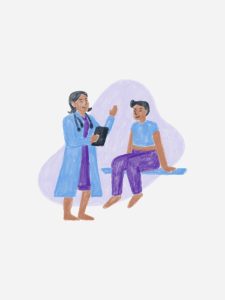
Anna Gosline, a participant of Dr Balboni’s panel, observed something deeply unsettling:
Healthcare systems have trained people to act like patients, not like humans.
Clinicians rarely ask:
What matters to you?
What makes you happy?
What gives your life meaning?
These questions sound too abstract.
So Anna and her team began adapting their methods and asking more direct questions.

When patients couldn’t answer
When researchers began asking patients about happiness and purpose, many people simply couldn’t answer.
Because no one had ever asked them before, the question was too abstract.
So, Anna and her team simplified it:
What do you enjoy doing?
What makes your day better?
When and where do you feel safe?
When are you most yourself?
When do you feel a part of something bigger than yourself?
And suddenly, people started to open up.
Healthcare became a team effort, and doctors had a better idea of how to support people in their daily lives.

The silent fear inside hospitals
Another interesting discovery from Balboni’s research:
Many patients do not have big expectations from their treatments, and they are afraid to question their doctors, afraid of being judged, receiving worse care or not being taken seriously.
Minority groups, in particular, reported feeling unseen and unheard during medical treatments.
When the professional team asked what their patients really wanted, the answer was simple:
“Someone who says: we’ll work and figure this out together.”

Redefining science and spirituality in healthcare
Ali Jablonski, another participant of Dr Balboni’s panel and a hospital chaplain, reported facing a unique challenge.
One of her patients told her, in a firm tone:
“I’m not religious. And if you’re going to talk about spirituality… well, I’m not spiritual either.”
So how can you support someone who rejects both? By redefining your language!

Spirituality without the word spirituality
Instead of asking about religion or beliefs, Dr Balboni’s team start asking:
Where do you find meaning?
When do you feel safe?
What gives you hope?
When do you feel most like yourself?
And for such questions, everyone had answers.
It wasn’t a right-or-wrong matter. Even though spirituality is not based on labels, it’s an experience that embraces people as they are.
Healing doesn’t always look clinical.
Sometimes, care doesn’t look like medicine at all.
Ali had to figure out a way to help all types of patients.
- They made a banner of chickens with tutus, set up a beauty salon in the hospital, and so on.
- During a beauty session with a patient who asked for rollers, the patient confessed that getting her hair done always felt grounding to her, almost like a church.
- The patient’s husband brought the team a fake plant (as they cannot have real ones) with rollers in each branch and thanked them for making his wife feel seen for the first time during her long journey in her healthcare.
- Her team also adopted Bob, the hospital service dog, who is a different healthcare provider.
- And they also dealt with people who came from an unsafe religious environment and felt even more vulnerable in a hospital. In these cases, animals can offer an extra layer of safety.
As a non-religious queer chaplain, she defines spirituality as “a dynamic and intrinsic aspect of humanity through which a person seeks meaning, purpose and transcendence. An experienced relationship to self, others, community, society, nature and its significance or sacredness”.
These moments may seem small.
But for patients, they represent being seen and being human.
Just being!

When spirituality meets science
David H. Rosmarin is a rabbi, a clinical psychologist, and another participant on Balboni’s panel. And he took it even further.
In response to his atheist advisor’s request, he created a spirituality-integrated cognitive-behavioural therapy group for the hospital where he worked.
Despite initial resistance from colleagues, it quickly became one of the most popular programs.
Why?
Because patients were asking questions that science alone couldn’t answer.
Questions like:
Why is this happening to me?
Where is God in all of this?
What does this suffering mean?
And Dr Rosmarin didn’t claim to have answers. But he sat with those people and validated their questions, feelings and struggles.
According to Dave, when he and his team discussed spirituality in a scientific context, they focused on providing high-quality care to each patient and humanising the treatment process.

The future of healthcare
Across all these perspectives, it became clear that healthcare is not just about curing diseases, but also about caring for the human experience of being alive.
And that includes:
- Meaning
- Purpose
- Connection
- Belonging
In simple words, spirituality is part of what makes us humans.
So, instead of asking yourself: “Should spirituality be part of healthcare?”
Start to expand on: “How the f*ck did we ever think it wasn’t?”

Healing the whole you
With the intersection of science and spirituality, a more complete vision of healing is emerging.
One where patients are no longer reduced to symptoms.
One where clinicians are not reduced to protocols.
And where care is not dictated only by money
But by presence, open communication, understanding, and humanity.
Healing is not complete by just fixing your sexy body. There is an entire system inside your beautiful carcass, mate!
It is more than time to be accountable for our acts.
And take care of us as the whole beings we are. 💛✨
How would healthcare change if every clinical interaction began with: What makes you feel most alive?
