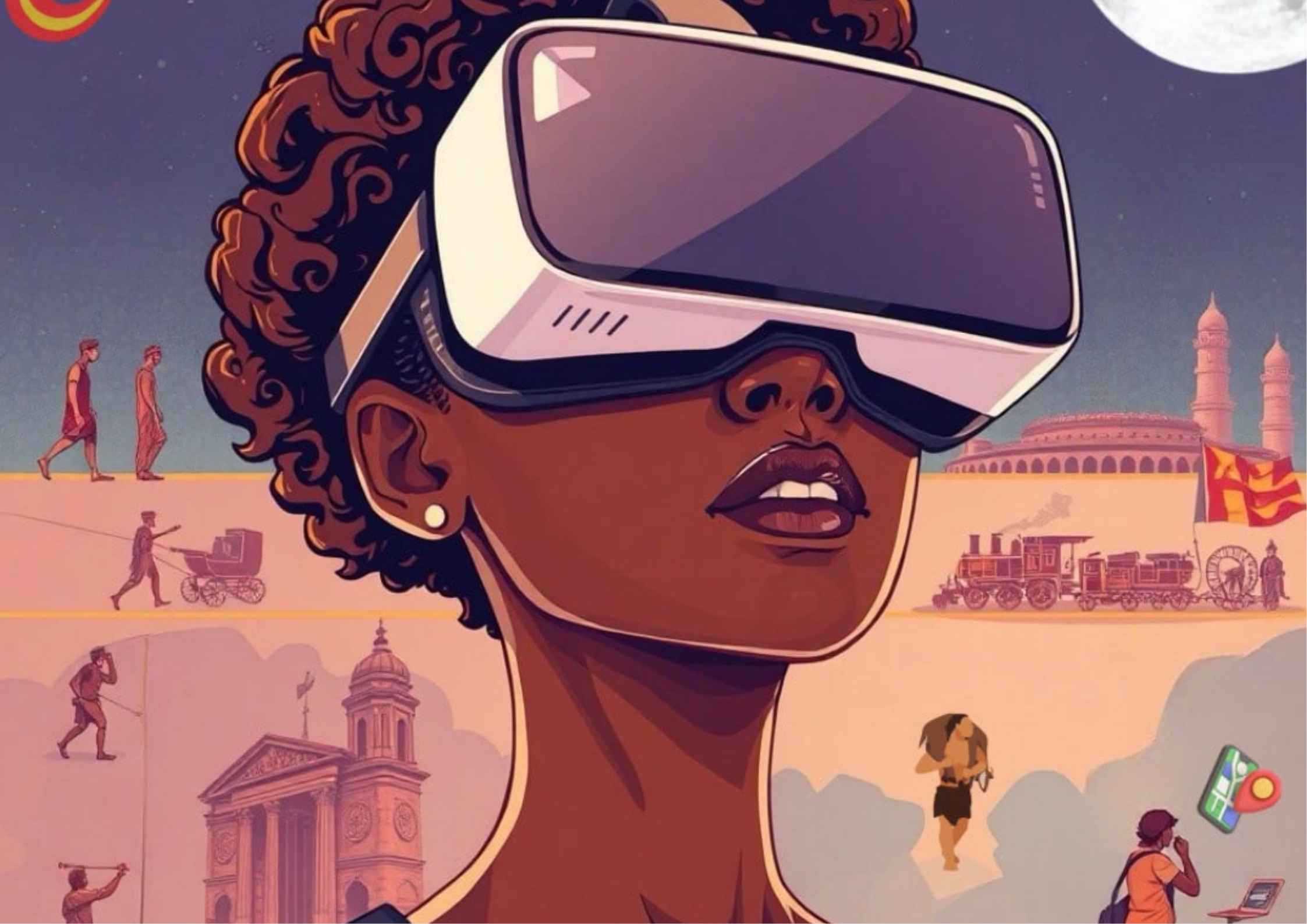

Have you ever wondered how the first trip happened?
What is the real history of travel and tourism?

How the heck did travel and tourism begin?
I have always been intrigued by it but had never taken the time to research how the first travel in humanity’s history happened, until now, when I realised this is the most logical way to start a travel blog.
History can be difficult to understand and absorb at times.
To spare you the effort, I’ll summarise hours of my research so you can discover how travel and tourism originated and how they have shaped travelling as we know it today.
What geology teaches us about travel and tourism
– And it’s mind-blowing!

If I haven’t mentioned it already, I have long internal dialogues.
As soon as one side of my brain kept pestering me, asking about the origin of travelling, the other side immediately responded, thinking about our Neanderthal cousins.
Wouldn’t seasonal changes and their saga for food be valid reasons for their groups to travel long distances?
And this, my friends, is my favourite discovery while writing this post: Geologists and Historians have increasing evidence that Neanderthals crossed the Mediterranean in boats 100.000 years ago!
More than that, according to The New Scientist, geologists on Flores Island, in Indonesia, have found one-million-year-old cold stone tools, indicating that Homo erectus possibly travelled and crossed the seas even before Neanderthals evolved.
Can you believe it? 🤯
Imagine yourself on an improvised boat, without a map or a compass, simply running to the unknown without having a minor idea of where you’re going.
Would you be brave enough to do something like this?
History of travel as tourism

With me, my friend, you’ll always have access to the complete gossip.
Do you know the origin of the word “tourism” and what other terms have been used in its place throughout history?
The word “Tourism” was first pronounced in English in 1811. It comes from the Old English term ‘Tur’an’, which came from the Ancient Greek ‘Tor’os’. It means to spin or to move.
Despite being totally into etymology —” a little less conversation, a little more action, please”.
Historically, how and where did tourism start, and how did it become so popular?
As Science Advances shows, Neanderthals travelled beyond Europe and Western Asia, breeding with another archaic human group, the Denisovans.
These incredible discoveries reveal they were creative and intelligent people with highly developed survival skills.
Yet, they did not travel for leisure, or at least there are no recorded instances of science being aware of such travel.
A brief(ish) timeline:
Travel and tourism in Ancient times

So, how did people start travelling?
History believes it began with the same people who conveniently popularised the roads: the Romans, specifically (but not surprisingly), the rich ones.
I bet life was pretty dull before this time, when people had to stay in the same place for their entire lives!
The first Roman roads were constructed in the earliest days of the Roman Republic (from approximately 509 BC to 27 BC) and expanded during the Roman Empire (from 27 BC to 476 AD).
They were constructed mainly for military purposes, but over time, they also became a means of trade, communication, transport, and access for the wealthiest to their summer villas for holiday use.
Through tourism, the Romans began to learn about other cultures, literature, cuisine, art, and more.
Travel and tourism in Medieval times

Spirituality and tourism are intertwined with our society’s history.
In the Middle Ages, pilgrimage became very popular among Christians, Buddhists and Muslims.
Between the 5th and 15th centuries, pilgrims began travelling long distances to pray, offer gifts, seek penance, or strengthen their faith.
The first recorded travel in China dates back to between 399 and 1279.
They varied from geographical and topographical information to inspiring songs and philosophical poems.
Asian Studies estimates that the first Chinese traveller was a 77-year-old man named Faxian, a pilgrim monk who visited India to learn their language and explored many temples to understand their Buddhist spiritual beliefs.
Modern Tourism or Grand Tour

What is the history of travel as tourism?
As we know today, travelling for leisure has its roots in The Grand Tour, which was (big news!) an exclusive activity for upper-class European men. 🤡
The first person to register an Eurotrip was a dude named Władysław Vasa, no less than the King of Poland.
It happened in 1611-12, while he was still a Prince, and he travelled to learn about military weapons and war tactics around Europe.
Only after 231 years, on 2 March 1842, Ida Pfeiffer became the first woman to travel solo.
She lied to her friends and family, saying she would travel to Constantinople so they wouldn’t worry or drag her off the ship.
The Austrian was indeed going to Constantinople, but from there she was already intending to go further, as far as the Red Sea. She decided to stay away for nine months.
The 19th century saw the introduction of the first trains and travel agencies.
Thomas Cook, an English businessman, called his son to become the pioneer of a company offering all-inclusive holidays for less, especially during the Industrial Revolution in the UK, which earned him the titles “The Founder of Travel” and “The Father of Travel.”
At the end of the 19th and the beginning of the 20th century, tourism reached a new level with the rise of buses and cars.
In 1923, the SS Ceylon became the first worldwide cruise to depart from Liverpool for a ten-month journey.
It passed through the Suez Canal into the Red Sea, across the Arabian and Indian Seas, and then via the South China Sea into the Pacific, before heading down the west coast of the Americas to round Cape Horn.
In the 20th century, particularly during World War II, so many people migrated that it became difficult for governments to determine their origins and repatriate them to their countries of origin.
As you can see in detail in this National Geographic article, things were getting so out of control that the League of Nations (now the United Nations) recognised the urgency of creating what we now know as a passport and obtained the United States’ full support to limit the inflow of immigrants.
Why is travel so important in human history?

In summary, travelling has shaped humanity, facilitating commerce, cultural exchange, exploration, migration, religious diffusion, education, and leisure.
Historic routes, classic destinations, and practices established in early times continue to attract travellers to this day.
The evolution of our transport system has made travelling more accessible and efficient for modern society.
Does the history of travel still connect
with today’s tourism? How?

Yes, it does. We have inherited historic investments in infrastructure, such as roads, buses, hotels, and railway systems.
Due to interconnected global networks, today’s travellers can access a broader range of destinations and experiences.
We cannot deny or minimise the impact of travelling as a means of survival, an impulse for change, or a source of inspiration for humans.
However, this practice has also impacted native people and our environment, and the time for action is now.
The historical exploitation of resources in tourism has led to a contemporary focus on sustainable practices, reminding the industry of the lessons we’ve learned about environmental and cultural preservation.
Crystal ball…
What is the future of tourism?

How has tourism evolved?
In this new and technological era, tourism workers can analyse travel history to better understand and adapt their methods to modern society’s behaviours and demands.
They can also utilise AI tools to analyse feedback and identify emerging behaviours, helping them maintain a strong market ranking.
To enhance our clients’ experiences, we can utilise virtual immersions, digital storytelling, interactive content, robots, high-tech exhibits, and new technologies that can be easily integrated into customer service, enabling our services to evolve.
Still, we cannot ignore the significant impact of our actions on our planet and its ecosystems, simply because we profit from them.
We must transform passive travel into active travel, promoting tourism that educates and repairs the beautiful planet we love exploring.
No matter how digital our society has become, authentic experiences and deep connections with nature and people will always be essential human necessities.
Tourism promises to be a dynamic and evolving landscape shaped by various trends and innovations.

Sustainability will be at the forefront in 2025, with travellers increasingly seeking eco-friendly options that minimise their environmental impact
Resilience and flexibility will be key elements in the future of tourism as the industry adapts to global changes, including economic fluctuations and climate challenges.
With an increasing focus on cultural awareness and sustainability, the future of travelling is set to be more conscious, personalised, and technology-driven.
Einstein says that where the energy of the masses is, so is the movement.
Let’s observe and learn from our history to create a new and powerful movement of reparation, equity, and respect for our home and others, reshaping the history of travel and tourism and creating experiences that are more than memorable – They are meaningful.
